Sustainable Development as a Framework for the Protection and Management of Cultural Heritage
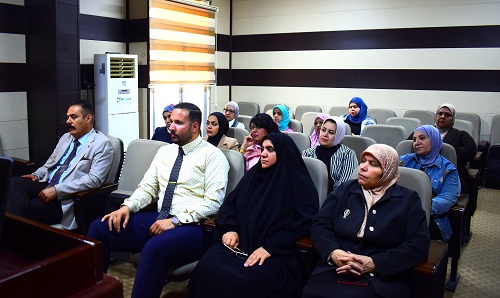
The Baghdad Documentation Department at the Center for the Revival of Arab Scientific Heritage, University of Baghdad, organized a workshop on Tuesday, 24/2/2026, , entitled “Sustainable Development of Heritage and the Management of Archaeological Sites.” The workshop was held in the hall of Professor Nabila Abdul-Munim Dawood, with the attendance of a distinguished group of professors, researchers, and those interested in heritage affairs.
The session was chaired by Dr. Rasha Issa Fares, Head of the Baghdad Documentation Department, who welcomed the attendees and emphasized at the beginning of the session the importance of integrating academic and institutional efforts in the field of preserving cultural and civilizational heritage. She also stressed the need to adopt modern scientific approaches that contribute to safeguarding the historical identity of Baghdad as a city with a rich civilizational legacy.
The workshop began with a lecture by Dr. Liqa Shakir Al-Sharifi, presenting her research entitled “Employing Sustainable Development in the Service of Baghdad’s Heritage.” In her presentation, she addressed the concept of sustainable development as a practical framework through which cultural heritage can be protected and invested in a balanced manner. She explained that applying sustainable development to Baghdad’s heritage contributes to strengthening national identity, stimulating the local economy, creating job opportunities, and raising societal awareness of the importance of preserving cultural legacy.
This was followed by a presentation from Assistant Lecturer Hajar Basim Mohammed, entitled “The Role of Sustainable Development in the Management of Archaeological Sites.” She discussed the concept of sustainable management of archaeological sites as a framework that achieves a balance between heritage preservation and its utilization for development purposes. This involves maintaining the archaeological site as a historical value while also employing it as an economic and social resource that serves the community. She reviewed the major challenges facing archaeological sites, such as increasing tourism, urban pressure, climate change, and limited funding, referring to international experiences. She also discussed the environmental, economic, and social dimensions of sustainable management and presented a practical five-stage model for managing archaeological sites in accordance with internationally recognized standards.
Both speakers emphasized that sustainable management is a fundamental requirement for ensuring the preservation and protection of cultural heritage for future generations.