Meet

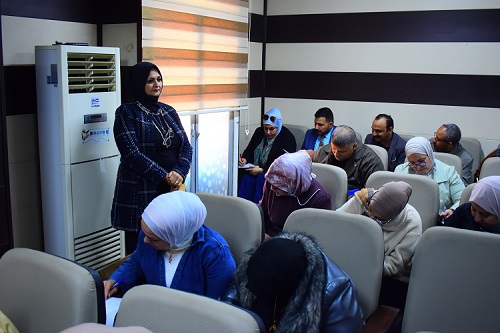
President of the University of Baghdad and Director of the Center for the Revival of Heritage Meet with the Japan Foundation to Discuss Supporting and Developing the Japanese Language Department at the College of Arts

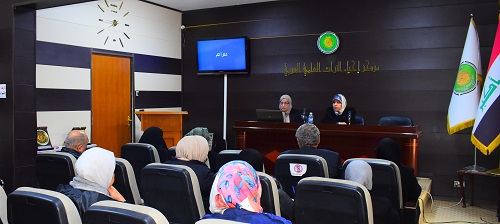
The University of Baghdad discussed  the prospects of academic and cultural cooperation with the Japan Foundation, aiming to enhance educational programs and develop the Japanese Language Department at the College of Arts. This took place during a meeting attended by Professor Dr. Bahaa Insaf Ibrahim, President of the University of Baghdad; Professor Dr. Ali Abdul Amir Sajit, Dean of the College of Arts; Professor Dr. Laith Majid Hussein, Director of the Center for the Revival of Arab Scientific Heritage; along with a number of representatives from the university and the college, and several members of the Japan Foundation. The meeting focused on discussing opportunities to support curricula, exchange expertise, and implement joint programs that would contribute to improving students’ skills and opening broader horizons for cultural communication between Iraq and Japan. Representatives of the University of Baghdad emphasized the importance of this partnership in supporting rare language specializations and providing a modern educational environment. Meanwhile, the delegation of the Japan Foundation expressed their readiness to cooperate in organizing training courses and providing advanced educational materials, in addition to exploring the possibility of hosting specialized professors and organizing joint cultural events.

597872053_1186719846893457_5491586361862941229_n

Congratulations on Victory Day

The administration of the Center for the Revival of Arab Scientific Heritage at the University of Baghdad extends its highest congratulations and blessings to the honorable Iraqi people on the occasion of the anniversary of the Iraqi Victory Day—this cherished national occasion that restored Iraq’s dignity, land, and the unity of its people.On this blessed occasion, Professor Dr. Laith Majid Hussein, Director of the Center, conveys his deepest feelings of pride and appreciation to the sons of our armed forces in all their branches, who, with their blood and sacrifices, embodied the finest images of heroism and wrote for Iraq a new chapter of glory and victory.

Announcement

The Center for the Revival of Arab Scientific Heritage announces the holding of its symposium entitled “World Arabic Language Day” on Thursday, December 18, 2025, at 10:00 a.m., in the Professor Nabeela Abdul-Munim Dawood Hall at our Center.

The invitation is open to everyone.

Seminar

The Center for the Revival of Arab Scientific Heritage Organizes a Seminar

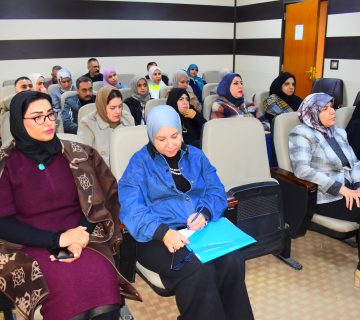
The Center for the Revival of Arab Scientific Heritage at the University of Baghdad organized a seminar on Monday, November 24, 2025, entitled “Repetition in the Holy Qur’an.” The event was held in Professor Nabeela Abdul Muneem Dawood Hall, with the attendance of several faculty members from the Center. The lecture was presented by Assistant instructor Hind Amer Fadel, a faculty member at the Center, who discussed repetition in the Qur’an as a prominent rhetorical device based on reiterating words or meanings to achieve various purposes. She explained that repetition is not a mere restatement without value; rather, it is used to affirm meaning and firmly embed it in the mind, especially in doctrinal matters that require clarification and emphasis, such as monotheism, resurrection, and prophethood. She added that repetition also helps attract the listener’s attention, appearing in different forms that suit the context and theme of each Surah. Repetition is evident in Qur’anic narratives, where events are retold in varying styles that introduce new meanings and highlight additional aspects of the story. It is also employed to enhance the Qur’anic rhythm and verbal harmony, which give the text its unique beauty and profound impact.

Thus, repetition is considered an artistic and rhetorical element that deepens understanding and highlights the miraculous nature of the Holy Qur’an.

Meetings

Director of the Center for the Revival of Arab Scientific Heritage Holds Preparatory Meetings for the 2025 Annual Conference

Professor Dr. Laith Majid Hussein, Director of the Center for the Revival of Arab Scientific Heritage at the University of Baghdad, held a series of meetings over two days with the Center’s staff as part of the ongoing preparations for the Seventh International Conference entitled “The History of Science Among the Arabs,” scheduled to be held on December 2–3, 2025. The meetings aimed to discuss the final stages of preparation and to finalize the necessary organizational arrangements to ensure the success of the conference’s activities. The meetings addressed the review of the conference’s scientific program, mechanisms for receiving participants and guests, and ways to enhance logistical support. Discussions also covered the provision of all required technical and administrative needs to organize a distinguished conference that reflects the Center’s scientific standing and ongoing efforts. During the meetings, the Director emphasized the importance of cooperation among all departments and effective coordination between academic and administrative staff. He affirmed that the success of the conference depends on teamwork, collective effort, and the optimal use of accumulated experience in organizing academic events. At the conclusion of the meetings, an agreement was reached on a set of executive procedures and follow-up schedules to ensure that all arrangements are completed ahead of the conference date and to create a supportive academic environment that enables the achievement of the conference’s intended goals.

Workshop

An Environmental Workshop Held by the Center for the Revival of Arab Scientific Heritage about the Environment and Drinking Water

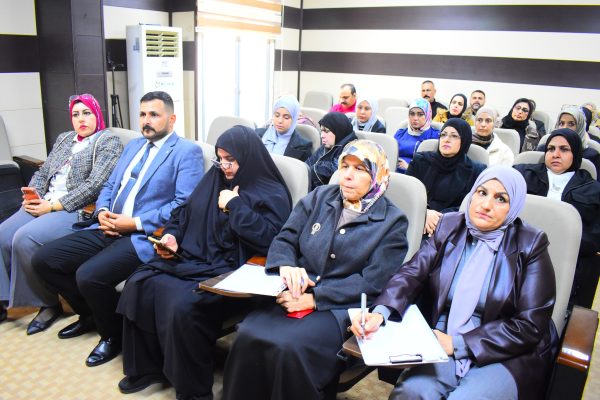
The Department of Human Studies at the Center for the Revival of Arab Scientific Heritage / University of Baghdad held a workshop on Wednesday, November 19, 2025, entitled “The Environment and Drinking Water Between Heritage and Modernity.” The event took place in Professor Nabeela Abdul Muneem Dawood Hall, with the attendance of a number of specialists and individuals interested in environmental affairs. The session was chaired by instructor Dr. Sahar Hassan Abdul Rasul and presented by biological researcher Farah Hatif from the Environmental Studies Department.

During the workshop, the researcher discussed the importance of sustainable development and its role in preserving water resources, with a particular focus on the sixth Sustainable Development Goal related to clean water and sanitation. She emphasized that ensuring access to safe and clean water for all is one of the most essential pillars of development in any society.

The workshop also reviewed traditional practices in water management and methods of water preservation throughout different eras, comparing them with modern techniques adopted by contemporary institutions to ensure the quality and safety of drinking water. This comparison highlighted the integration between traditional expertise and modern scientific knowledge.

The workshop included several key objectives, most notably raising awareness about the importance of protecting water sources, promoting positive behaviors in water consumption, and enhancing societal understanding of the environmental challenges related to the water sector.

The researcher concluded with several recommendations, the most important of which were strengthening cooperation between governmental and community institutions to protect water resources, supporting projects that contribute to improving water quality, intensifying awareness programs on the sustainable use of water, and ensuring its preservation for future generations.

The workshop also featured several discussions on methods of safety and prevention when dealing with unsafe water. At the end of the event, the Center’s administration thanked the researcher for efforts and wished continued success and prosperity.

585884390_1170696151829160_2051198205158003338_n
586825930_1170695671829208_2012967068242377139_n

Community service

Staff of the Center for the Revival of Arab Scientific Heritage Organize a Volunteer Campaign to Clean the Center

In an effort to promote teamwork and institutional responsibility, the Center for the Revival of Arab Scientific Heritage at the University of Baghdad organized a volunteer campaign on the morning of Tuesday, October 14, 2025, to clean the Center’s corridors and courtyards.This campaign is part of the Center’s initiatives aimed at instilling values of belonging and dedication among its staff. It sought to create a clean and well-prepared work environment that enhances performance efficiency, while also strengthening team spirit through active participation in fieldwork

565073293_1141570168075092_3626990512152540670_n
566316027_1141570888075020_1385814791705871082_n

Field Visit

On the morning of Tuesday, October 14, 2025, under the direct guidance of Professor Dr. Laith Majeed Hussein, Director of the Center, the Center for the Revival of Arab Scientific Heritage at the University of Baghdad organized a field visit to the Al-Salihiyah Orphanage for Children, affiliated with the Ministry of Labor and Social Affairs.

The visit included several faculty members and staff from the Center and was part of its efforts to strengthen humanitarian engagement, social cooperation, and values of solidarity. The delegation was warmly received by the orphanage administration, headed by Ms. Ward Mahdi Habib, Director of the orphanage. The visit focused on exploring opportunities for future collaboration and follow-up visits to support this special group within the community. The team also presented gifts and moral support to the children. At the conclusion of the visit, the Director expressed her gratitude and appreciation to the Center for its thoughtful initiative, emphasizing its role in promoting humanitarian and social initiatives.

563456059_1141262621439180_338129024464840511_n
565634571_1141262411439201_2013674185037305270_n

The Status of the Teacher between Heritage and Modernity

The Center for the Revival of Arab Scientific Heritage Organizes a Scientific Symposium: “The Status of the Teacher between Heritage and Modernity”

Under the supervision of Professor Dr. Laith Majeed Hussein, Director of the Center for the Revival of Arab Scientific Heritage at the University of Baghdad, the Department of Humanities organized a scientific symposium on the morning of Wednesday, October 15, 2025, attended by a number of academics and researchers, in the Hall of Professor Nabeela Abdul Muneim Dawood.

The symposium was entitled “The Status of the Teacher between Heritage and Modernity” and was chaired by Professor Dr. Salar Ali Khudair, Head of the Department of Humanities at the Center. The event included the participation of several researchers, each presenting studies highlighting the role and significance of teachers across different eras and contexts:

Professor Dr. Salah Rasheed Al-Salhi, retired from the Department of Ancient History, presented a study on the Akkadian and Sumerian eras, focusing on the status of the teacher during these historical periods and reviewing the development of literary and scientific outputs among the Akkadians and Sumerians.

Professor Dr. Wasan Hussein Muheimid, a faculty member at our Center, discussed the educational impact of family and teachers in the Abrahamic religions, emphasizing religious texts of Judaism and Christianity that contain educational concepts applied across various developmental stages, from childhood to adulthood.

Assistant Professor Dr. Sahar Hassan Abdul Rasool presented a study on education in the Islamic era, highlighting the importance of understanding texts, the conditions for acquiring knowledge, the role of reason in comprehending truths, and how learners attain scientific results.

Assistant Professor Dr. Sundus Zidan Khalaf addressed the status of teachers during the Ottoman era, explaining the Ottoman state’s efforts to develop education for its interests, including the establishment of schools such as Al-Rashidiya and Al-Kaldaniya.

Assistant Professor Raed Hamad Al-Rubaie from the Directorate General of Education in Diyala presented a study entitled “Teachers’ Rights and Learners’ Etiquette in Islamic Heritage,” outlining teachers’ rights as highlighted by Muslim scholars, including Imam Ali ibn Abi Talib and his grandson Imam Zain al-Abidin, and emphasizing their leadership and educational role derived from religious values.

Assistant Professor Dr. Imtithal Kazem Sarhan, a faculty member at our Center, concluded the symposium with a study on the status of the teacher in the modern era, emphasizing the teacher’s role as an educator and guide, and highlighting how modern educators act as leaders in the learning process, using technology to enhance teaching and develop various skills.

The symposium included several scholarly interventions and discussions. At its conclusion, the Center’s administration expressed gratitude to all contributors for this distinguished symposium, highlighting the teacher’s status and wishing them continued success in their academic endeavors, serving both our university and beloved Iraq.

565755901_1142111278020981_5283982451728245089_n
563453741_1142110874687688_8226834244611457931_n
564560615_1142110878021021_1087645123074085180_n

Seminar on the Ziyadid State in Yemen

The Center for the Revival of Arab Scientific Heritage Holds a Seminar on the Ziyadid State in Yemen

Under the supervision of Professor Dr. Laith Majeed Hussein, Director of the Center for the Revival of Arab Scientific Heritage at the University of Baghdad,the Center held a seminar on Thursday, October 16, 2025, attended by a number of professors and researchers, in the Hall of Professor Nabeela Abdul Muneim Dawood.

The seminar was entitled “The Ziyadid State in Yemen”, and the lecture was delivered by Assistant Professor Dr. Sahar Hassan Abdul Rasool, a faculty member in the Center.

Dr. Rasool discussed the numerous disturbances and conflicts in Yemen and explained that, in order to restore stability, the region of Tihama was separated, an independent government was established, and a new governor was appointed to secure order in the region. This authority was one of the Yemeni leaderships based in the western areas of Mikhlaf Ja‘far, while another competing power also existed.

The Abbasid Caliphate recognized the Ziyadid authority and granted it legitimacy in exchange for nominal allegiance. Muhammad bin Ziyad ruled from 204 to 245 AH, followed by Ibrahim from 245 to 289 AH, and then Ishaq bin Ibrahim Abu al-Jaish in 391 AH. The state expanded its territory to the south of Aden, and its relations with the Abbasid Caliphate were strong, deriving political legitimacy from it.

The center of heritage revival organizes workshop

Under the supervision of Professor Dr. Laith Majeed Hussein, Director of the Center for the Revival of Arab Scientific Heritage at the University of Baghdad, the Center held on Monday, October 20, 2025, and in the presence of a number of professors and researchers, an off-schedule workshop entitled “Strengthening Moral Structure and Highlighting the Dangers of Homosexuality” in the Hall of Professor Nabila Abdul Muneim Dawood. Professor Dr. Anas Issam Ismail, a faculty member at the Center, delivered the lecture, in which he discussed the historical context of homosexuality, referencing its mention in the Holy Qur’an and the divine punishment inflicted upon the people of Lot (peace be upon him). He explained that such acts are considered a deviation from divine and natural law and contrasted this with the Islamic perspective, which has clearly defined rulings on the matter for over 1,400 years

He further noted that promoting homosexuality under the slogans of “freedom” and “human rights” serves as a tool for weakening the moral fabric of societies. The lecturer emphasized the importance of strengthening religious and intellectual awareness to reinforce authentic ethical values.

The workshop included several interventions and discussions. In conclusion, the Center’s administration expressed its gratitude to the lecturer and wished him continued success and prosperity

567684433_1145867107645398_6972907346449475227_n
568639740_1145867070978735_7669066040632512986_n

The Center for the Revival of Arab Scientific Heritage Organizes a workshop

Under the supervision of Professor Dr. Laith Majeed Hussein, Director of the Center for the Revival of Arab Scientific Heritage at the University of Baghdad, the Manuscripts Department in the Center organized a panel discussion on the morning of Thursday, October 9, 2025, attended by a number of professors and researchers, and held in the Hall of Professor Nabeela Abdul Muneim Dawood. The panel discussion was entitled “Scientific Research Methodologies between Heritage and Modernity.” The session was chaired by Dr. Liqaa Amer Ashour, a faculty member at our Center, and the lecture was delivered by Assistant Professor Dr. Nihad Ne’ma Majeed from the Department of History, College of Education for Women. Dr. Majeed began by defining history as the science that studies human events of the past, aiming to understand these events, their timing, locations, causes, and outcomes. She emphasized that studying and writing history requires deep analysis, patience, and precise reading and examination of texts.

The researcher highlighted the importance of the historical method, which records, describes, and analyzes past events systematically and scientifically to reach accurate conclusions. This, in turn, helps us understand the present in light of the past and anticipate the future.

She also pointed out that early historians used two main methods in historical research:

The annalistic method, which confines events to specific time and place frameworks, helping readers focus within a defined context and better follow the sequence of events. The contemporary historical methodologies, which aim to understand interconnections and reveal deep links between past and present phenomena across time and space. These modern approaches transcend traditional boundaries, moving beyond purely national or regional events to present a broader view of relationships among different societies. The discussion included several scholarly interventions and exchanges of views on research methodologies.

At the conclusion of the session, Dr. Zainab Kamel, Head of the Manuscripts Department, expressed her appreciation to Dr. Majeed, wishing her continued success and excellence in serving our distinguished university.