The center ofHeritage Revival Center Organizes a Scientific Seminar

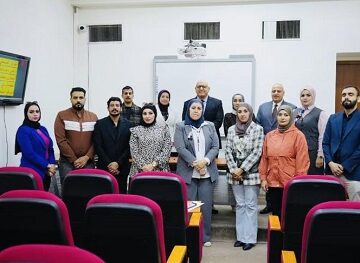
The Department of Pure Sciences at the Arab Scientific Heritage Revival Center / University of Baghdad organized its scientific seminar on the morning of Tuesday, 7/4/2026, entitled “The Art of Crisis Management: Between the Past and the Present,” with the attendance of a distinguished group of professors and researchers, as well as a notable delegation from the Great Mosque of Kufa. The session was chaired by Dr. Sundus Zaidan Khalaf, a faculty member at the Center, who opened the seminar with welcoming remarks, emphasizing the importance of crisis management in light of the rapidly evolving global challenges. She also noted that the seminar aimed to shed light on historical experiences in dealing with crises and linking them to contemporary data in a way that contributes to building more efficient scientific and practical visions. The seminar outlined its key themes, which included studying crises across time, analyzing their causes, and proposing ways to address them, with a focus on contemporary models relevant to current realities. Among the أبرز presentations was that of Assistant Lecturer Hind Amer Fadhil, who discussed crisis management through the ages, highlighting lessons from the past and perspectives of the present. She examined the development of crisis management approaches over time and emphasized the importance of benefiting from historical experiences in addressing current crises. Assistant Lecturer Wasan Adel Abdul Wahab, also from the Center, presented her research paper on “The Political Crisis in Iraq: Causes and Solutions – Water Scarcity as a Model,” in which she analyzed the causes of political crises, focusing on water scarcity and its impacts, and proposed a number of possible solutions. The seminar also featured several other research presentations that enriched the academic discussion and deepened the understanding of crisis management from multiple perspectives. The seminar concluded with a set of recommendations, enhancing the exchange of scientific expertise among academic institutions, benefiting from historical experiences in confronting contemporary crises, supporting applied research in crisis management, and developing effective strategies to address current challenges, particularly in the fields of water and politics.