Participation in thesis committee

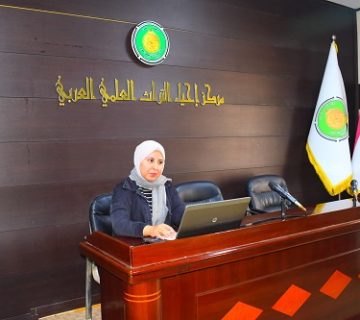
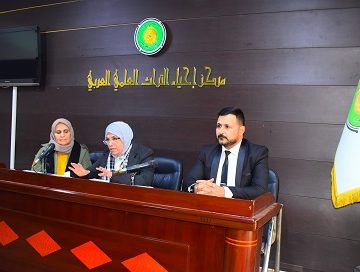
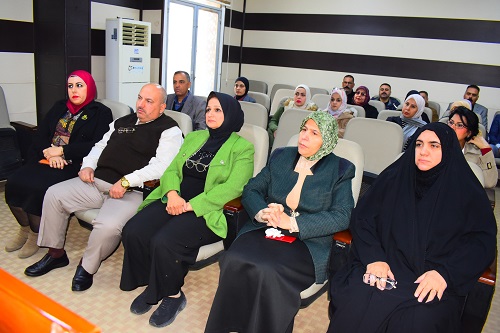
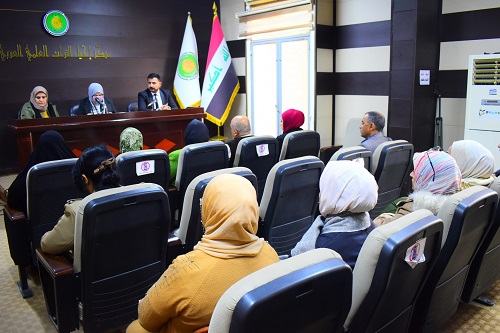
Asst. Prof. Dr. Rasha Issa Faris, a faculty member at the Center for the Revival of Arabic Scientific Heritage at the University of Baghdad, participated on Thursday, October 30, 2025, in the Dar Al-Salam Hall at the Union of Arab Historians, as a member of the examination committee for the Ph.D. membership  submitted by the student Shaimaa Fadel Nassif, entitled “The Intellectual Movement in Samarkand through Al-Dhahabi’s Tarikh al-Islam (748 AH / 1374 AD)”, at the Institute of Arab History and Scientific Heritage for Postgraduate Studies.

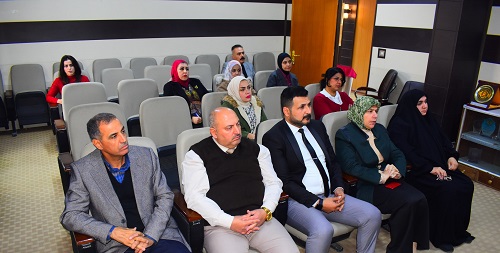
The defense was attended by a number of professors and researchers specializing in Islamic history and scientific heritage. After reviewing the committee’s report, the student was awarded the degree of Excellent (Distinction). Congratulations to the student, with best wishes for continued success and progress in her academic journey.

527721457_1083914443840665_4972151800628805972_n

seminar “The Differences in Qur’anic Readings

The center of heritage revival organizes seminar “The Differences in Qur’anic Readings and Their Impact on the Variation of Meaning,”

Under the supervision of Prof. Dr. Laith Majid Hussein, Director of the Center for the Revival of Arabic Scientific Heritage at the University of Baghdad, our Center organized a seminar on Tuesday, October 28, 2025, at 12:00 p.m., in Professor Nabeela Abdul Muneem Dawood Hall, with the attendance of several of the Center’s staff members.

The seminar, entitled “The Differences in Qur’anic Readings and Their Impact on the Variation of Meaning,” was delivered by Asst. Prof. Dr. Iman Saleh Mahdi, a faculty member at our Center. Dr. Mahdi discussed the scholars’ stance on citing Qur’anic readings as evidence. She explained that when the movement of compiling works on Qur’anic readings—both mutawatir (widely transmitted) and irregular (shadhdh)—became active, referring to these readings became an essential necessity in establishing grammatical and linguistic rules. She noted that the use of Qur’anic readings as linguistic evidence began in the Basra and Kufa schools, but the grammarians of the two schools differed in their approaches. The Basrans, since the time of Sibawayh, sought to subject these readings to their established grammatical rules and analogies; they accepted and cited those that conformed to their principles and rejected those that did not, labeling them as irregular.

Participates in the Eighth Scientific Conference

The Center for the Revival of Arabic Scientific Heritage Participates in the Eighth Scientific Conference of the General Authority for Antiquities and Heritage

At the invitation of the General Authority for Antiquities and Heritage, the Center for the Revival of Arabic Scientific Heritage at the University of Baghdad participated in the activities of the Eighth Scientific Conference entitled “The Civilizational Role of the City of Baghdad Through Historical Eras.” The conference was held under the patronage of Dr. Ahmed Fakak Al-Badrani, Minister of Culture, Tourism, and Antiquities, and under the supervision of Mr. Qasim Taher Al-Sudani, Deputy Minister, under the slogan “Baghdad: Authenticity and Everlasting Splendor.”

The conference took place on Monday, October 27, 2025, at 10:00 a.m., in the Cordoba Hall of the Al-Mansour Melia Hotel in Baghdad, with the participation of a distinguished group of researchers, academics, and specialists in the fields of history, archaeology, and heritage. During their participation, representatives of the Center emphasized the importance of such conferences in documenting Iraq’s civilizational heritage and supporting national efforts aimed at preserving cultural identity and strengthening the sense of belonging to the deep-rooted history of the capital, Baghdad.

573072959_1150341660531276_2172968386952635061_n

workshop Enhancing the Role of Women

Under the supervision of Prof. Dr. Laith Majid Hussein, Director of the Center for the Revival of Arabic Scientific Heritage at the University of Baghdad, our Center organized a scientific workshop on Sunday, October 26, 2025, at 11:00 a.m., in cooperation with the Center for Strategic Studies and under the patronage of the Women’s Affairs Division at the University of Baghdad. The workshop was attended by a number of female researchers and was held in Professor Nabeela Abdul Muneem Dawood Hall. The workshop, entitled “Enhancing the Role of Women in Political Work and Decision-Making,” was chaired by Asst. Prof. Dr. Rasha Issa Faris, Head of the Baghdad Documentation Department and faculty member at our Center. The lecture was delivered by Asst. Prof. Dr. Rana Mouloud Shaker, faculty member at the Center for Strategic and International Studies at the University of Baghdad.

Dr. Shaker discussed the importance of strengthening women’s participation in decision-making, emphasizing that it is one of the essential conditions for building a genuine and inclusive democracy. She noted that this process requires integrated efforts, represented through several recommendations — including the need for active government entities to enact supportive legislation, strengthening the family’s role in raising children on the principle of support and confidence, particularly for women, and the use of media to craft positive discourse, imagery, and attitudes toward women.

571346082_1151061143792661_2317165163424545686_n
571216195_1151061250459317_5711649937299331457_n
571225640_1151061270459315_8505367999925842373_n

I am text block. Click edit button to change this text. Lorem ipsum dolor sit amet, consectetur adipiscing elit. Ut elit tellus, luctus nec ullamcorper mattis, pulvinar dapibus leo.

more

Participation

Professor Wasan Hussein Muhimid, from the Department of Human Studies in the Center, participated in the scientific symposium organized by Dar Najm Al-Mashriq Cultural House for Publishing and Distribution, affiliated with the Chaldean Patriarchate in Baghdad, entitled “Father Yousif Habbi (1938–2000): The Man and the Thinker”, marking the 25th anniversary of his passing. The symposium was held on Monday, October 20, 2025, at the hall of Mar Gorgis Chaldean Church in Al-Ghadeer. It was attended by His Beatitude Cardinal Louis Raphael Sako, Patriarch of the Chaldean Church in Iraq and the world; his assistant Bishop Basilios Yaldo; H.E. Professor Dr. Mohammed Hussein Al-Yasien, President of the Iraqi Scientific Academy; along with a distinguished group of researchers, academics, and intellectuals from various scientific institutions, Baghdadi councils, and those interested in the thought of Father Habbi.

Dr. Wasan presented a paper entitled “The father Dr. Yousif Habbi and His Role in Preserving the Syriac Heritage”, shedding light on his scholarly activities and contributions to academic conferences, scientific institutions, and both local and international journals through his chairmanship of the Syriac Committee at the Iraqi Scientific Academy. Dr. Wasan received the Father Yousif Habbi Award for Excellence and Creativity for her paper, which was recognized as the best research presented at the symposium.

In conclusion, the Center’s administration extended their thanks and congratulations to Dr. Wasan, wishing her continued success and achievement in her academic career.

565941599_1147056294193146_4722516621256601636_n

Center for the Revival of Arab Scientific Heritage Organizes a Workshop

Under the supervision of Professor Dr. Laith Majeed Hussein, Director of the Center for the Revival of Arab Scientific Heritage at the University of Baghdad, the Department of Pure Sciences at the Center organized a workshop on Wednesday, October 22, 2025, held in Professor Nabeela Abdul Muneim Dawood Hall, that attended by a number of professors and academics.  The workshop,entitled “Historical Factors Behind the Emergence of Cities in the Upper Euphrates Region,” was chaired by Professor Dr. Taha Subti Ibrahim, Head of the Department of Pure Sciences at our Center. The lecture was delivered by Professor Dr. Saadi Ibrahim Al-Darraji, a retired faculty member of the Center, who discussed the most significant historical factors that contributed to the establishment and continuity of settlement in the Upper Euphrates cities. Among these factors were geographical, economic, administrative and political, military, and social aspects.

Dr. Al-Darraji particularly emphasized the economic factor, especially trade and ancient transportation routes, as well as traditional industries and the importance of agricultural activity in the cities of the region. He also highlighted the historical significance of ancient urban centers with deep roots in history, such as Anah, Haditha, Al-Wus, and Jubbah, noting that most of them emerged along the Euphrates on small fortified islands dating back at least to the Assyrian era, with continuous habitation throughout the Sasanian, Roman, and Islamic periods. The researcher further discussed archaeological sites and major cultural landmarks in the cities of the Upper Euphrates, presenting examples of military, religious, and public architecture. The workshop included several academic discussions and contributions related to the topic. In conclusion, the Center’s administration expressed its appreciation to the distinguished researcher, wishing him continued success in his scholarly endeavors.

571003333_1147838140781628_7049004126714648153_n
570109910_1147838010781641_2807873858843049753_n

Seminar

Under the supervision of Professor Dr. Laith Majeed Hussein, Director of the Center for the Revival of Arab Scientific Heritage at the University of Baghdad, our Center organized a seminar on Thursday, October 23, 2025, at 10:00 a.m., held in Professor Nabeela Abdul Muneim Dawood Hall and attended by a number of professors and academics. The seminar, titled “The City of Kufa: Its Urban Planning and Cultural Landmarks,” was delivered by Assistant Lecturer Zainab Jamal Nawroz, a faculty member in the Center. she discussed the origins and development of the city of Kufa, which was founded in 638 AD as a military camp and later evolved into an important urban center.

Nawroz highlighted that Kufa was distinguished by its orderly and geometric urban design, featuring straight, well-organized streets arranged around a central market and a grand mosque. The city served as a political and administrative center during the Islamic era and attracted scholars, jurists, and intellectuals. She added that Kufa’s civilization blended both military and urban characteristics, and the city was known for its public buildings, markets, and advanced social facilities. Its Great Mosque became a center for Islamic jurisprudence and Arabic linguistics, contributing significantly to the spread of knowledge and culture.

The lecture emphasized Kufa’s role as a hub of cultural and political activity during the early Islamic period, reflecting its prominent position in the history of Islamic civilization.

569919847_1148678340697608_7560929439883623496_n

Director of the Center for Revival of Heritage Participates in an International Conference

Director of the Center for Revival of Heritage Participates in an International Conference

sponsored by the center of the Hassan bin Mohammed Center for the Study of Ancient Arabia, and with the participation of the University of Baghdad, the international conference held in the Qatari capital, Doha, convened its second symposium titled “Animals in Ancient Arabia” from October 25 to 26, 2025.

Professor Laith Majid Hussein, Director of the Center for the Revival of Arab Scientific Heritage at the University of Baghdad, took part in the conference with his research paper titled “Animals in the Kingdom of Hatra (Iraq): An Artistic and Civilizational Study.”

The conference also featured the participation of numerous Arab and European scholars, whose valuable research enriched the event by discussing ancient inscriptions, archaeological evidence, and textual sources that reflect the relationship between humans and animals in pre-Islamic Arabia.

573072959_1150341660531276_2172968386952635061_n

Community service

Staff of the Center for the Revival of Arab Scientific Heritage Organize a Volunteer Campaign to Clean the Center

In an effort to promote teamwork and institutional responsibility, the Center for the Revival of Arab Scientific Heritage at the University of Baghdad organized a volunteer campaign on the morning of Tuesday, October 14, 2025, to clean the Center’s corridors and courtyards.This campaign is part of the Center’s initiatives aimed at instilling values of belonging and dedication among its staff. It sought to create a clean and well-prepared work environment that enhances performance efficiency, while also strengthening team spirit through active participation in fieldwork

565073293_1141570168075092_3626990512152540670_n
566316027_1141570888075020_1385814791705871082_n

Field Visit

On the morning of Tuesday, October 14, 2025, under the direct guidance of Professor Dr. Laith Majeed Hussein, Director of the Center, the Center for the Revival of Arab Scientific Heritage at the University of Baghdad organized a field visit to the Al-Salihiyah Orphanage for Children, affiliated with the Ministry of Labor and Social Affairs.

The visit included several faculty members and staff from the Center and was part of its efforts to strengthen humanitarian engagement, social cooperation, and values of solidarity. The delegation was warmly received by the orphanage administration, headed by Ms. Ward Mahdi Habib, Director of the orphanage. The visit focused on exploring opportunities for future collaboration and follow-up visits to support this special group within the community. The team also presented gifts and moral support to the children. At the conclusion of the visit, the Director expressed her gratitude and appreciation to the Center for its thoughtful initiative, emphasizing its role in promoting humanitarian and social initiatives.

563456059_1141262621439180_338129024464840511_n
565634571_1141262411439201_2013674185037305270_n

The Status of the Teacher between Heritage and Modernity

The Center for the Revival of Arab Scientific Heritage Organizes a Scientific Symposium: “The Status of the Teacher between Heritage and Modernity”

Under the supervision of Professor Dr. Laith Majeed Hussein, Director of the Center for the Revival of Arab Scientific Heritage at the University of Baghdad, the Department of Humanities organized a scientific symposium on the morning of Wednesday, October 15, 2025, attended by a number of academics and researchers, in the Hall of Professor Nabeela Abdul Muneim Dawood.

The symposium was entitled “The Status of the Teacher between Heritage and Modernity” and was chaired by Professor Dr. Salar Ali Khudair, Head of the Department of Humanities at the Center. The event included the participation of several researchers, each presenting studies highlighting the role and significance of teachers across different eras and contexts:

Professor Dr. Salah Rasheed Al-Salhi, retired from the Department of Ancient History, presented a study on the Akkadian and Sumerian eras, focusing on the status of the teacher during these historical periods and reviewing the development of literary and scientific outputs among the Akkadians and Sumerians.

Professor Dr. Wasan Hussein Muheimid, a faculty member at our Center, discussed the educational impact of family and teachers in the Abrahamic religions, emphasizing religious texts of Judaism and Christianity that contain educational concepts applied across various developmental stages, from childhood to adulthood.

Assistant Professor Dr. Sahar Hassan Abdul Rasool presented a study on education in the Islamic era, highlighting the importance of understanding texts, the conditions for acquiring knowledge, the role of reason in comprehending truths, and how learners attain scientific results.

Assistant Professor Dr. Sundus Zidan Khalaf addressed the status of teachers during the Ottoman era, explaining the Ottoman state’s efforts to develop education for its interests, including the establishment of schools such as Al-Rashidiya and Al-Kaldaniya.

Assistant Professor Raed Hamad Al-Rubaie from the Directorate General of Education in Diyala presented a study entitled “Teachers’ Rights and Learners’ Etiquette in Islamic Heritage,” outlining teachers’ rights as highlighted by Muslim scholars, including Imam Ali ibn Abi Talib and his grandson Imam Zain al-Abidin, and emphasizing their leadership and educational role derived from religious values.

Assistant Professor Dr. Imtithal Kazem Sarhan, a faculty member at our Center, concluded the symposium with a study on the status of the teacher in the modern era, emphasizing the teacher’s role as an educator and guide, and highlighting how modern educators act as leaders in the learning process, using technology to enhance teaching and develop various skills.

The symposium included several scholarly interventions and discussions. At its conclusion, the Center’s administration expressed gratitude to all contributors for this distinguished symposium, highlighting the teacher’s status and wishing them continued success in their academic endeavors, serving both our university and beloved Iraq.

565755901_1142111278020981_5283982451728245089_n
563453741_1142110874687688_8226834244611457931_n
564560615_1142110878021021_1087645123074085180_n