the center of heritage revival organizes seminar

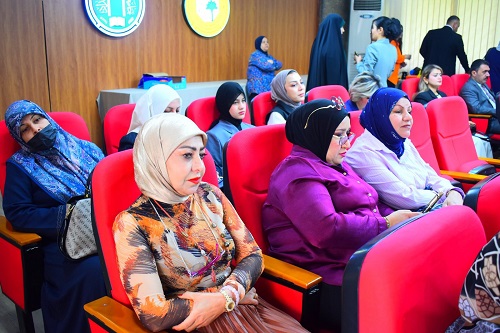
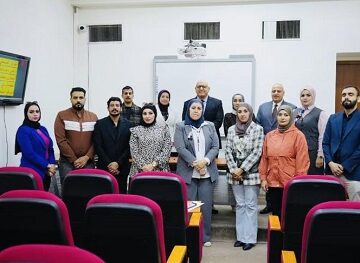
The Center for the Revival of Arab Scientific Heritage at the University of Baghdad organized a scientific seminar on Wednesday, April 22, 2026, entitled “The Historical Geography of Epidemics and Their Impact on Population Distribution.” The lecture was presented by researcher assistant instructor Wasan Adel Abdul Wahab, a faculty member at the center, in the Professor Nabila Abdul Munim Dawood Hall. The seminar was well-attended by researchers and academics and addressed in-depth topics concerning the historical impact of health geography on understanding human transformations.
The researcher discussed how diseases spread across space and time and their pivotal role in shaping the world’s population map. She presented examples of epidemics as demographic drivers and considered them a decisive historical factor in changing population density and patterns of human settlement.
The researcher also discussed some of these diseases, including the Black Death, which caused a sharp decline in the population of Europe and led to widespread migrations and changes in population centers. She also examined the experience of the Americas, where the spread of diseases after the arrival of Europeans led to a decrease in the indigenous population and a radical change in the demographic composition. The study reinforces the role of geographical and dispersal factors, including climate, transportation routes, and urban congestion, in accelerating the spread of epidemics, particularly in major cities. The researcher focuses on the consequences of migration and population redistribution, as well as economic and demographic changes whose effects are still evident in the modern era.