The Center for the Revival of Arab Scientific Heritage Organizes a Seminar

The Center for the Revival of Arab Scientific Heritage at the University of Baghdad organized a scientific seminar on Tuesday, April 28, 2026, entitled “Types of Archaeological Sites and Their Role in Preserving Heritage in Ancient Iraq.” The seminar was presented by Assistant Lecturer Milad Mohammed Yassin, a faculty member at the Center, at Professor Nabila Abdul Munim Dawood Hall.

The researcher presented an analytical study of archaeological sites as material archives that have preserved the development of human civilization in Mesopotamia throughout different historical periods. He provided a detailed classification of these sites, beginning with caves that witnessed the earliest forms of human settlement, and extending to archaeological mounds that represent successive historical layers reflecting the transformation of societies from simple communities to complex urban civilizations.

He also highlighted the documentation role of monuments and military fortresses, explaining how these landmarks embodied the cultural identity and military and defensive awareness of ancient humans. In addition, he emphasized the importance of archaeological burial sites and the artifacts and funerary objects they contain, considering them a rich source for understanding the social structures and traditions that prevailed during those periods.

In conclusion, the researcher focused on the significance of these discoveries in reconstructing a comprehensive picture of Iraq’s history and documenting the development of language, writing, and economic activities.

This activity comes as part of the series of scientific events organized by the Center to promote awareness of national heritage and highlight the enduring civilizational legacy of Mesopotamia.

The Center for the Revival of Heritage Organizes a Seminar “

The Center for the Revival of Arab Scientific Heritage at the University of Baghdad organized a specialized scientific seminar this morning, Sunday, April 26, 2026, entitled “Scientific and Administrative Traditions in Old Baghdad Schools and Their Impact on Current Schools.” The seminar, held in the Professor Nabila Abdul-Munim Dawood Hall, was attended by a number of professors and researchers and presented by instructor Dr. Leqaa’ Amer Ashour, a lecturer in the Manuscripts Department and a faculty member at our center.

The researcher demonstrated that these institutions were not merely centers of learning, but rather integrated “administrative systems” that laid the foundations for what we know today as modern universities. She focused on two main axes: the scientific traditions in organizing the relationship between professor and student, and the system of “scientific licenses,” which are considered the historical origin of academic degrees, as well as the methods of dialogue, debate, and gradual progression in acquiring knowledge; and the administrative traditions that highlighted the high level of institutional organization, including the endowment system that ensured the continuity of education, the uniform dress code, and comprehensive social welfare for students.

The researcher also emphasized that contemporary academic practices in current universities, including career progression, teaching methods, and administrative structures, are merely an extension and development of those original foundations that originated in Baghdad, thus demonstrating the city’s pioneering role in shaping the concept of the “educational institution.”

The session included valuable contributions from the attending professors, enriching the topic with intellectual and historical discussions and underscoring the importance of reviving this legacy to strengthen the academic identity of Iraqi educational institutions.

Cooperation Between the Center for Reviving Heritage and the Center for Urban Planning

Towards a Safe Environment: Cooperation Between the Center for Reviving Heritage and the Center for Urban Planning

On Thursday April 23, 2026, Professor Dr. Laith Majeed Hussein, Director of the Center for Reviving Arab Scientific Heritage at the University of Baghdad, received Professor Dr. Karim Hassan Alwan, Dean of the Center for Urban and Regional Planning for Graduate Studies. A joint meeting was held to discuss ways to enhance scientific and practical cooperation between the two institutions, reflecting the growing interest in safety and civil defense issues.

The meeting addressed mechanisms for developing public safety systems and civil defense procedures within both institutions, emphasizing the importance of exchanging expertise and knowledge in risk management, emergency planning, and raising the level of preparedness for crises.

The two parties also reviewed several proposals aimed at building a sustainable partnership. These proposals included organizing joint workshops and training courses, launching specialized research projects in urban safety and safe planning, and promoting open scientific cooperation and the exchange of data and expertise among researchers.

At the conclusion of the meeting, both sides affirmed their commitment to developing frameworks for future cooperation that contribute to achieving a safe scientific and institutional environment and support efforts to disseminate a culture of safety and civil defense at both the academic and community levels.

678751955_1290184243213683_3109797331449033390_n
675234981_1290183939880380_5767963546935950636_n

the center of heritage revival organizes seminar

The Center for the Revival of Arab Scientific Heritage at the University of Baghdad organized a scientific seminar on Wednesday, April 22, 2026, entitled “The Historical Geography of Epidemics and Their Impact on Population Distribution.” The lecture was presented by researcher assistant instructor Wasan Adel Abdul Wahab, a faculty member at the center, in the Professor Nabila Abdul Munim Dawood Hall. The seminar was well-attended by researchers and academics and addressed in-depth topics concerning the historical impact of health geography on understanding human transformations.

The researcher discussed how diseases spread across space and time and their pivotal role in shaping the world’s population map. She presented examples of epidemics as demographic drivers and considered them a decisive historical factor in changing population density and patterns of human settlement.

The researcher also discussed some of these diseases, including the Black Death, which caused a sharp decline in the population of Europe and led to widespread migrations and changes in population centers. She also examined the experience of the Americas, where the spread of diseases after the arrival of Europeans led to a decrease in the indigenous population and a radical change in the demographic composition. The study reinforces the role of geographical and dispersal factors, including climate, transportation routes, and urban congestion, in accelerating the spread of epidemics, particularly in major cities. The researcher focuses on the consequences of migration and population redistribution, as well as economic and demographic changes whose effects are still evident in the modern era.

The Center for Reviving Heritage Organizes a Workshop on Women and Sustainability

On Tuesday, April 21, 2026, Assistant instructor Juman Adnan Hussein, a member of the Women’s Affairs Unit at the Center for Reviving Arab Scientific Heritage at the University of Baghdad, organized a workshop entitled “The Evolution of Women’s Role in Natural Resource Management: Past and Present – A Geographical Study.” Held in the Professor Nabila Abdul-Munim Dawood Hall, the workshop  shed light on the strategic shift in women’s role in resource management.

Assistant instructor  Juman Adnan Hussein started the session by emphasizing that women have always been, and remain, the primary guardians of nature. She noted that the workshop aimed to understand how this role has evolved from simple traditional practices to scientific and technical contributions that shape international policies.

Assistant instructor Walaa Dhiaa Nassif presented a detailed overview of significant historical milestones, highlighting the pivotal role of women in natural resource management and the significant development of this role throughout history. She explained how women in ancient and rural societies possessed a deep understanding of the land through their responsibilities for collecting water and firewood, as well as farming, thus creating a natural and sustainable relationship with the environment. The researcher explained that the qualitative shift of women into the fields of planning and institutional management, their role in modern agriculture, biodiversity protection, water crisis management, and the role of international organizations and modern laws in transforming women’s skills from the limited framework of the family to an active and influential role at the national and global levels. The attendees enriched the workshop with interventions that focused on the need to integrate the traditional knowledge that women possess with modern technology to ensure the sustainability of resources. At the conclusion of the workshop, M.M. Juman praised the scientific presentations made by M.M. Walaa, stressing that women’s empowerment is the cornerstone for facing the environmental challenges of the twenty-first century.

678878465_1288588920039882_4510632277176784705_n

Workshop

the Center of heritage revival Organizes a Workshop “Industrial Heritage: Between Reality and Aspiration.”

The Manuscripts Department at the Arab Scientific Heritage Revival Center / University of Baghdad organized a workshop on Tuesday morning, April 14, 2026, entitled “Industrial Heritage: Between Reality and Aspiration.” The event was attended by a number of professors and researchers and was held at the Nabeela Abdul Munim Dawood Hall.

The lecture was delivered by Professor Dr. Zainab Kamel Karim, a faculty member at the Center, who addressed in her presentation the vital role of industrial heritage in highlighting civilizational identity, emphasizing its importance in documenting the course of industrial development across different eras.

She also reviewed the challenges facing this type of heritage and the ways to preserve and maintain it, in addition to the importance of employing it in academic and research studies in a manner that contributes to achieving integration between the past and the present.

The workshop further stressed the importance of developing comprehensive strategies that link the preservation of industrial identity with its development in line with contemporary demands, while striving to achieve a balance between protecting historical value and ensuring economic feasibility.

The researcher added that while aspirations remain high, they require institutional will and cooperation among relevant bodies to transform this heritage from a neglected burden into a sustainable developmental resource. The workshop witnessed notable interaction, enriching the academic discussion on prospects for advancing interest in industrial heritage and enhancing its presence within the cultural landscape.

This workshop comes as part of the Center’s ongoing scientific activities aimed at shedding light on various aspects of Arab scientific heritage and reviving it in ways that serve both present and future generations.

670139246_1283565940542180_765894033646697871_n

the Center of heritage revival  Organizes Field Visit to Orphan Care Home in Al-Salihiya

Under the direct guidance of Prof. Dr. Laith Majeed Hussein, Director of the Arab Scientific Heritage Revival Center, University of Baghdad, the Center organized a field visit on Monday, 13/4/2026, to the Orphanage in Al-Salihiya, affiliated with the Ministry of Labor and Social Affairs.The visiting delegation included a group of the Center’s members and staff. This visit came as part of the Center’s commitment to strengthening cooperation and communication with social institutions and supporting the most vulnerable groups in society.  The delegation was received by Ms. Worood Mahdi Habib, Director of the home. During the visit, both sides emphasized the importance of continued joint cooperation to support orphaned children and to provide them with the necessary care and attention.

The visit included the presentation of gifts and moral support to the children, reflecting the Center’s commitment to its humanitarian and social responsibility. At the conclusion of the visit, the Director of the home expressed her gratitude and appreciation to the visiting delegation from the Center, praising this humanitarian initiative that contributes to supporting and caring for this important segment of society.

669688440_1282419867323454_2966008291859016894_n

The Center for the Revival of Arab Scientific Heritage Organized a Seminar on Al-Istrabadi Market in Al-Kadhimiya

The Center for the Revival of Arab Scientific Heritage at the University of Baghdad organized a distinguished scientific seminar on Sunday, April 12, 2026, entitled “Al-Istrabadi Market in Al-Kadhimiya: A Renewed Heritage.” The seminar was presented by Dr. Imtithal Kazim Sarhan, a faculty member at the Center, in the presence of a group of professors and researchers at Professor Nabila Abdul Munim Dawood Hall. In her lecture, Dr. Sarhan addressed the historical and cultural significance of Al-Istrabadi Market as one of the most prominent heritage landmarks in the city of Al-Kadhimiya. She reviewed its establishment, development throughout different eras, and its vital role in the economic and social activities of the area. She also highlighted the architectural characteristics of the market and its distinctive heritage identity, which reflects the character of the city, referring to the efforts made to preserve and revive it in a manner that meets contemporary requirements without compromising its historical authenticity. The lecturer emphasized the necessity of enhancing community awareness regarding the importance of preserving heritage markets, as they represent the memory and spirit of cities. She also called for intensifying initiatives that contribute to safeguarding this cultural legacy. The seminar witnessed notable interaction from the attendees, with numerous questions and discussions that enriched the dialogue and highlighted the importance of the topic in strengthening cultural identity and preserving historical heritage.

Visit

Visit of the Editor-in-Chief of “Afaq Furatiah” to the Arab Scientific Heritage Revival Center to Enhance Joint Cooperation

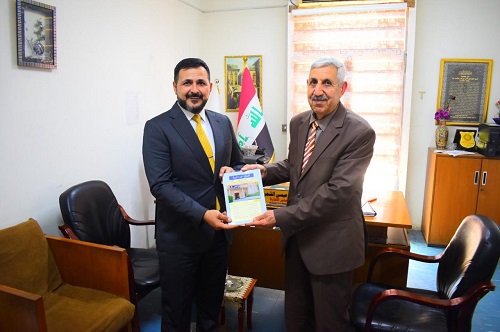
The administration of the Arab Scientific Heritage Revival Center at the University of Baghdad received Mr. Jawad Abdul-Kadhim Mohsen, Editor-in-Chief of the journal “Afaq Furatiah” (Cultural Ambassador of Al-Musayyib), on the morning of Wednesday, 8/4/2026, in a scientific and cultural visit. He was welcomed by Mr. Firas Issa Fares, Director of the Center’s Administration.

During the visit, Mr. Jawad Abdul-Kadhim presented a copy of the 16th issue of the journal “Afaq Qur’aniyah” as a gift to the Center. The issue included distinguished coverage of several of the Center’s activities, featuring news and photographs highlighting its scientific and cultural contributions. The Center’s administration praised the important role the journal plays in documenting and following up Qur’anic and scientific activities, emphasizing its significant value in providing both media and knowledge support.

The meeting also included fruitful discussions between both sides on ways to enhance mutual cooperation in a manner that serves their scientific and cultural goals, contributes to the development of joint work, and highlights the efforts being made in the field of reviving Arab scientific heritage.

At the conclusion of the visit, both parties expressed their commitment to strengthening future cooperation and coordination in order to achieve further success and constructive collaboration.

668865713_1279096594322448_5703794230448196583_n

The center ofHeritage Revival Center Organizes a Scientific Seminar

The Department of Pure Sciences at the Arab Scientific Heritage Revival Center / University of Baghdad organized its scientific seminar on the morning of Tuesday, 7/4/2026, entitled “The Art of Crisis Management: Between the Past and the Present,” with the attendance of a distinguished group of professors and researchers, as well as a notable delegation from the Great Mosque of Kufa. The session was chaired by Dr. Sundus Zaidan Khalaf, a faculty member at the Center, who opened the seminar with welcoming remarks, emphasizing the importance of crisis management in light of the rapidly evolving global challenges. She also noted that the seminar aimed to shed light on historical experiences in dealing with crises and linking them to contemporary data in a way that contributes to building more efficient scientific and practical visions. The seminar outlined its key themes, which included studying crises across time, analyzing their causes, and proposing ways to address them, with a focus on contemporary models relevant to current realities. Among the أبرز presentations was that of Assistant Lecturer Hind Amer Fadhil, who discussed crisis management through the ages, highlighting lessons from the past and perspectives of the present. She examined the development of crisis management approaches over time and emphasized the importance of benefiting from historical experiences in addressing current crises. Assistant Lecturer Wasan Adel Abdul Wahab, also from the Center, presented her research paper on “The Political Crisis in Iraq: Causes and Solutions – Water Scarcity as a Model,” in which she analyzed the causes of political crises, focusing on water scarcity and its impacts, and proposed a number of possible solutions. The seminar also featured several other research presentations that enriched the academic discussion and deepened the understanding of crisis management from multiple perspectives. The seminar concluded with a set of recommendations, enhancing the exchange of scientific expertise among academic institutions, benefiting from historical experiences in confronting contemporary crises, supporting applied research in crisis management, and developing effective strategies to address current challenges, particularly in the fields of water and politics.

668450423_1278439991054775_5457227834016358223_n
666306974_1278439987721442_2682239004466398679_n

Kufa Mosque Secretariat Honors Participants of the 15th International Cultural Ambassador Festival

The Secretariat of the Great Mosque of Kufa honored a number of participants in the activities of the 15th International Cultural Ambassador Festival, in recognition of their outstanding contributions and active participation in the success of the festival’s events.  Among those honored was Prof. Dr. Zainab Kamel Kareem, a faculty member at the Arab Scientific Heritage Revival Center, University of Baghdad. Her participation as a representative of the Center reflected a distinguished academic presence and an effective contribution to this cultural gathering. The recognition included the awarding of a shield and a certificate of appreciation, through which the Secretariat expressed its gratitude for the efforts made in supporting cultural and intellectual activities and in تعزيز the message and humanitarian and cultural goals of the festival.

In its statement of recognition, the Secretariat affirmed that this honor comes in appreciation of sincere dedication and an active role in promoting cultural awareness, wishing the researcher continued success and perseverance in serving society and strengthening knowledge-based values.  the International Cultural Ambassador Festival is considered one of the most prominent cultural events hosted by the Secretariat of the Great Mosque of Kufa, bringing together a distinguished group of intellectuals, academics, and creatives from around the world to promote cultural dialogue and exchange of expertise

Heritage Revival Center Pays a Courtesy Visit to Prof.

Authenticity of Place and Stature of Knowledge… Heritage Revival Center Pays a Courtesy Visit to Prof. Nabila Abdul Munim Dawood in Al-Kadhimiya

In an academic and humanitarian gesture reflecting loyalty to pioneers of knowledge, a delegation from the Arab Scientific Heritage Revival Center, headed by Prof. Dr. Laith Majeed Hussein, Director of the Center, and accompanied by a number of distinguished faculty members, paid a visit to Prof. Nabila Abdul Munim Dawood in the holy city of Al-Kadhimiya.

The visit aimed to check on her health and to acknowledge her rich academic journey. During the meeting, the delegation expressed their deep appreciation for her exceptional contributions to the service of Arab heritage, wishing her continued health and well-being so she may carry on her impactful scholarly contributions that have enriched the Arab intellectual library for many years.

The meeting featured an engaging discussion on her latest academic achievements, followed by a tour of her private scholarly library. The delegation viewed a valuable collection of rare books and manuscripts, reflecting the depth of her specialization and the precision of her research throughout her academic career.

At the conclusion of the visit, Prof. Nabila expressed her sincere gratitude and deep appreciation for this kind initiative from the Center’s faculty, praising the vital role the Center plays in preserving heritage and supporting scholars. She also wished everyone continued success and prosperity in their noble academic mission.