Workshop

Under the Slogan: “Sign Language as a Bridge of Communication”

The Center for the Revival of Arab Scientific Heritage Organizes a Workshop

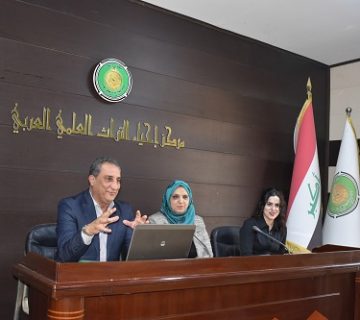
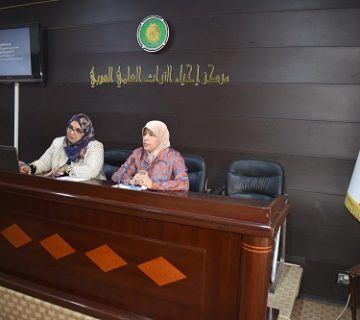
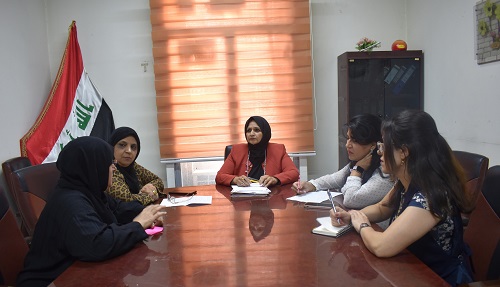
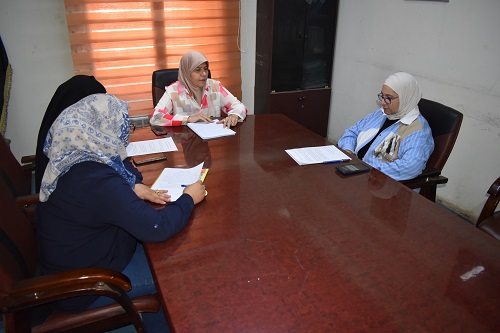
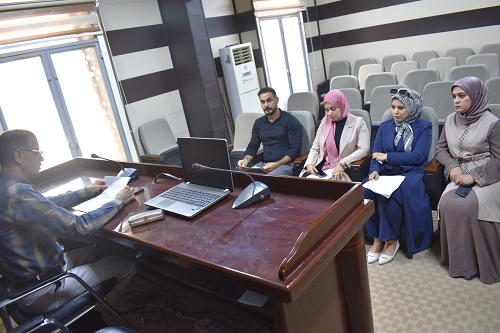
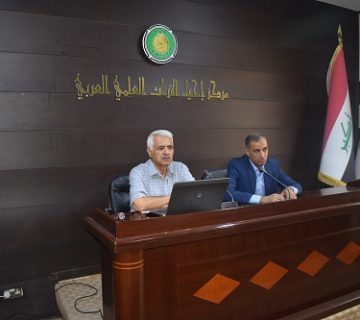
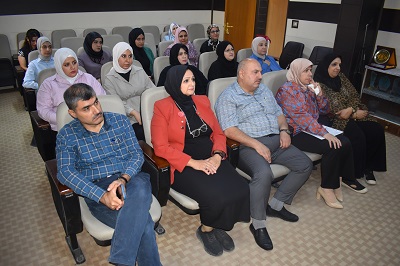
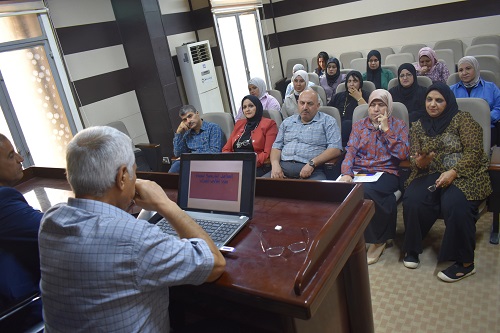
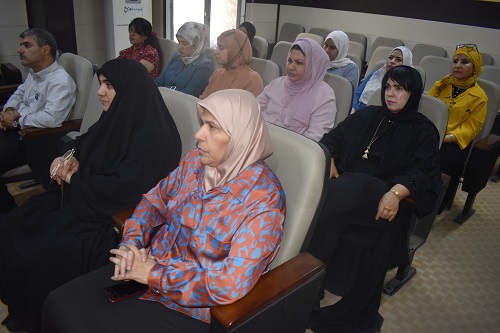
 In accordance with the directives of the Presidency of the University of Baghdad / Department of Media and Government Communication, the Media Unit at the Center for the Revival of Arab Scientific Heritage organized an educational awareness workshop on Wednesday morning, November 26, 2025, at 10:00 a.m., titled “The Role of Educational Institutions in Supporting the Deaf and Mute.” The workshop was held in Professor Nabeela Abdul Muneem Dawood Hall, with the attendance of several professors and academics. It was presented by Assistant Professor Dr. Zainab Kamil Kareem and Lecturer Dr. Liqaa Shakir Al-Sharifi, both faculty members at the Center. Dr. Liqaa Al-Sharifi delivered her research titled “The Rights of the Deaf and Mute in Iraq Between Legislation and Implementation.” The study examined the legal framework regulating the rights of the deaf and mute in Iraq, highlighting the legislation that guarantees their rights to education, healthcare, social welfare, and social integration. Al-Sharifi discussed the gap between what the laws stipulate and what is actually implemented on the ground, pointing out the challenges this group faces, such as the lack of specialized services, the shortage of staff trained in sign language, and limited societal awareness. She emphasized the need to strengthen governmental and institutional efforts to ensure that the deaf and mute have full access to their rights and are empowered to participate effectively in society.

Dr. Zainab Kamil then presented an overview of her research titled “Famous Figures Who Challenged Disability and Transformed It into Success Stories.” The study focused on a selection of Arab and international personalities who faced various disabilities—including hearing impairments—and succeeded in transforming these challenges into sources of strength and creativity. She highlighted examples of individuals who achieved exceptional success in fields such as science, art, sports, and community work, despite their disabilities. The research illustrated how their stories have become a source of inspiration and motivation for empowering the deaf and mute community, promoting a culture of optimism and resilience, and encouraging educational institutions to provide greater support. It also demonstrated the role of these figures in reshaping societal perceptions of disability and highlighting the capabilities of persons with disabilities.

The workshop included several discussions, and at its conclusion, the Media Unit Supervisor expressed gratitude to the two researchers for their dedicated efforts in serving the University and our beloved Iraq.

589953964_1176074857957956_8745517444162845597_n
587111910_1176074854624623_8518052261525382974_n

Training

Female Faculty Members of the Center for the Revival of Arab Scientific Heritage Participate in a Training Workshop within the Activities of Anti-Drug Week

A group of female faculty members from the Center for the Revival of Arab Scientific Heritage at the University of Baghdad participated on Monday, November 17, 2025, in a training workshop organized by the Center for Continuing Education at the University of Baghdad as part of the activities of Anti-Drug Week. The workshop was presented by Professor Dr. Arkan Saeed Khattab, Director of the Center, with the attendance of a number of specialists and individuals concerned with awareness-related issues. The workshop addressed the main themes related to the drug epidemic, the most prominent methods of combating it, and the negative effects it leaves on society. It also discussed modern prevention strategies and the role of educational institutions in raising awareness among students and promoting healthy and responsible behavior. The participating faculty members showed clear engagement through presenting viewpoints and scientific interventions that contribute to supporting national efforts aimed at limiting the spread of drugs, emphasizing the importance of continuing such awareness programs within the university environment.

The workshop concluded with an emphasis on the importance of integrating the roles of scientific and educational centers to enhance community awareness and develop sustainable training programs in the field of drug prevention.

Workshop“The Influence of Baghdad on Fine Arts,”

The Center of the Revival of Arab Scientific Heritage Organizes a Workshop“The Influence of Baghdad on Fine Arts,”

Under the supervision of Professor Dr. Laith Majid Hussein, Director of the Center for the Revival of Arab Scientific Heritage at the University of Baghdad, the Baghdad Documentation Department organized a workshop on Wednesday, November 5, 2025in the Professor Nabeela Abdul Muneem Dawood Hall. it was attended by a number of researchers and academics specializing in art, sociology, and cultural heritage. The workshop, entitled “The Influence of Baghdad on Fine Arts,” the lecture presented by Assistant Lecturer Surur Mohammed Khalil from the College of Arts – University of Baghdad. She discussed Baghdad’s pioneering role as a complex social and cultural space that has contributed to shaping the aesthetic structure of Iraqi fine art. She emphasized that this art cannot be understood apart from the social and historical structures that produced it. The discussion addressed Baghdadi art as a symbolic system reflecting the dynamics of Iraqi society and its transformations through periods of prosperity, conflict, and war. The researcher also presented examples from the works of Jawad Salim and his colleagues in the Baghdad School of Modern Art, highlighting their embodiment of the dialectical relationship between the artist and society. According to Pierre Bourdieu’s concept of the artistic field, the artist interacts with social structures, values, and institutions to produce visual symbols that express collective identity and reveal a symbolic capital tied to place and history. The workshop aimed to emphasize the significance of Baghdadi fine art, which is not merely an aesthetic practice but a visual social discourse documenting the transformations of collective consciousness and expressing the spirit of the city — between nostalgia and resistance, continuity of heritage, and the question of modernity. The session included several interventions discussing the importance of art and heritage. At the conclusion of the workshop, the center’s administration thanked the researcher, wishing her continued success in serving the University of Baghdad and beloved Iraq.

576871304_1160120282886747_2176658762735677659_n
576958998_1160119939553448_5091764726479486752_n

The center of heritage revival organizes scientific symposium 

Under the supervision of Professor Dr. Laith Majid Hussein, Director of the Center for the Revival of Arab Scientific Heritage at the University of Baghdad, the Baghdad Documentation Department organized a scientific seminar on Sunday, 16 November 2025, in Professor Nabeela Abdul Muneem Dawood Hall, titled “Baghdad, the City of Peace.” Lecturer Dr. Liqaa Shakir Al-Sharifi opened the session by highlighting Baghdad’s presence in classical and modern poetry, followed by presentations from a group of specialized researchers who discussed various historical, cultural, and social aspects of the city. The seminar featured notable contributions, including studies on Baghdadi customs in the Ottoman era, the city’s historical neighborhoods, and the symbolic significance of its cultural and political monuments. The concluding presentation explored Baghdad’s portrayal in Dr. Taha Al-Rawi’s work “Baghdad, the City of Peace.” Participants emphasized the importance of supporting scholarly research on Baghdad’s heritage and promoting a culture of peace. The session concluded with the Center’s Director expressing gratitude to the attending professors and researchers for their valuable contributions

581317528_1168556365376472_9182277298312705091_n
583296823_1168556305376478_3665944556842914597_n

The Center for the Revival of Arab Scientific Heritage Organizes a Workshop

Under the supervision of Professor Dr. Laith Majid Hussein, Director of the Center for the Revival of Arab Scientific Heritage at the University of Baghdad, the Manuscripts Department in the Center organized a workshop on Thursday, 13 November 2025, in Professor Nabeela Abdul Muneem Dawood Hall, with the attendance of a number of researchers and academics. The workshop was titled “Private Education in the Historical Perspective and Its Impact on Iraqi Society.” Professor Dr. Zainab Kamil Kareem and Lecturer Dr. Liqaa Shakir Al-Sharifi, both are members in the Center, presented the lecture. They discussed private education as one of the most important sectors in developed countries, as it provides future generations capable of development and innovation. In contrast, in less developed countries, the private sector still does not play an effective role in society, given that the state is considered the largest and most capable institution of managing a sensitive and strategic field such as education. The workshop aimed to shed light on the history of private education

The Center for the Revival of Arab Scientific Heritage Holds a Scientific Seminar

581908315_1166267245605384_3066943699159172439_n

Heads of Scientific Departments Discuss the Strategic Research Plan for 2026

Under the supervision of Prof. Dr. Laith Majid Hussein, Director of the Center for the Revival of Arabic Scientific Heritage at the University of Baghdad, an extensive meeting was held that brought together the heads of departments:

Prof. Dr. Salar Ali Khudhur (Department of Human Studies),

Prof. Dr. Taha Sibti Ibrahim (Department of Pure Sciences),

Prof. Dr. Zainab Kamel Kareem (Department of Manuscripts), and

Asst. Prof. Dr. Rasha Issa Faris (Department of Baghdad Documentation).

The meeting focused on discussing the scientific research plan for 2026 and all matters related to the development of new research projects.

The participants discussed the main themes and mechanisms for unifying research efforts in ways that serve the community, preserve national identity, and keep pace with modern scientific developments. They also agreed on establishing a timeline for submitting research proposals and forming regular subcommittees to follow up on the implementation and evaluation of the plan, ensuring high research quality and achieving the Center’s strategic goals.

At the conclusion of the meeting, the researchers expressed their gratitude to the Center’s administration for its continuous support of scientific research, affirming their commitment to continued collaboration in pursuit of their academic aspirations for the year 2026.

574599652_1157154396516669_6029728165504556727_n
574562848_1157155653183210_5375750202362743174_n
574289261_1157155353183240_888451929204736687_n
574882611_1157154806516628_6491787423198022404_n

Center for the Revival of Arab Scientific Heritage Organizes a Workshop

Under the supervision of Professor Dr. Laith Majeed Hussein, Director of the Center for the Revival of Arab Scientific Heritage at the University of Baghdad, the Department of Pure Sciences at the Center organized a workshop on Wednesday, October 22, 2025, held in Professor Nabeela Abdul Muneim Dawood Hall, that attended by a number of professors and academics.  The workshop,entitled “Historical Factors Behind the Emergence of Cities in the Upper Euphrates Region,” was chaired by Professor Dr. Taha Subti Ibrahim, Head of the Department of Pure Sciences at our Center. The lecture was delivered by Professor Dr. Saadi Ibrahim Al-Darraji, a retired faculty member of the Center, who discussed the most significant historical factors that contributed to the establishment and continuity of settlement in the Upper Euphrates cities. Among these factors were geographical, economic, administrative and political, military, and social aspects.

Dr. Al-Darraji particularly emphasized the economic factor, especially trade and ancient transportation routes, as well as traditional industries and the importance of agricultural activity in the cities of the region. He also highlighted the historical significance of ancient urban centers with deep roots in history, such as Anah, Haditha, Al-Wus, and Jubbah, noting that most of them emerged along the Euphrates on small fortified islands dating back at least to the Assyrian era, with continuous habitation throughout the Sasanian, Roman, and Islamic periods. The researcher further discussed archaeological sites and major cultural landmarks in the cities of the Upper Euphrates, presenting examples of military, religious, and public architecture. The workshop included several academic discussions and contributions related to the topic. In conclusion, the Center’s administration expressed its appreciation to the distinguished researcher, wishing him continued success in his scholarly endeavors.

571003333_1147838140781628_7049004126714648153_n
570109910_1147838010781641_2807873858843049753_n

Seminar

Under the supervision of Professor Dr. Laith Majeed Hussein, Director of the Center for the Revival of Arab Scientific Heritage at the University of Baghdad, our Center organized a seminar on Thursday, October 23, 2025, at 10:00 a.m., held in Professor Nabeela Abdul Muneim Dawood Hall and attended by a number of professors and academics. The seminar, titled “The City of Kufa: Its Urban Planning and Cultural Landmarks,” was delivered by Assistant Lecturer Zainab Jamal Nawroz, a faculty member in the Center. she discussed the origins and development of the city of Kufa, which was founded in 638 AD as a military camp and later evolved into an important urban center.

Nawroz highlighted that Kufa was distinguished by its orderly and geometric urban design, featuring straight, well-organized streets arranged around a central market and a grand mosque. The city served as a political and administrative center during the Islamic era and attracted scholars, jurists, and intellectuals. She added that Kufa’s civilization blended both military and urban characteristics, and the city was known for its public buildings, markets, and advanced social facilities. Its Great Mosque became a center for Islamic jurisprudence and Arabic linguistics, contributing significantly to the spread of knowledge and culture.

The lecture emphasized Kufa’s role as a hub of cultural and political activity during the early Islamic period, reflecting its prominent position in the history of Islamic civilization.

569919847_1148678340697608_7560929439883623496_n

Visit

A delegation from the Center for Kufa Studies, headed by Professor Dr. Hasanein Jaber Al-Helou, Director of the Center, along with a number of professors and researchers, visited the Center of heritage revival on the morning of Tuesday, June 24, 2025. The delegation was received by Dr. Laith Majid Hussein, Director of the Center for the Revival of Arab Scientific Heritage at the University of Baghdad. During the meeting, both parties discussed the organization of joint scientific activities, including the planning of seminars, conferences, and collaborative scientific and cultural events in the future. These efforts aim to foster the exchange of expertise, advance knowledge, and build bridges of academic cooperation between researchers and scholars. The visit concluded with the presentation of a copy of the Center for Kufa Studies Scientific Journal to the Center—an initiative reflecting mutual appreciation and a shared commitment to strengthening future collaboration. Dr. Hussein expressed his gratitude to the visiting delegation and wished them continued success and prosperity.

510801975_1052821413616635_3719339054402458861_n
512715663_1052820846950025_1291107972203810797_n
499835218_1052821106949999_6443575317909430992_n

seminar

Center of heritage revival organizes a seminar “Geographical Thought in al-Iṣṭakhrī’s Work.”

Under the supervision of Assistant Professor Dr. Laith Majid Hussein, (Director of the Center for the Revival of Arab Scientific Heritage ) at the University of Baghdad, the Center organizes a seminar entitled “Geographical Thought in al-Iṣṭakhrī’s Work.” The seminar, held in the lecture hall of Professor Nabeela Abdul Muneem Dawood, The lecture was delivered by Assistant Lecturer Walaa Dhiaa Nassif, a faculty member at our Center. She spoke about Abu Ishaq Ibrahim ibn Muhammad al-Farisi al-Iṣṭakhrī, one of the most prominent Muslim geographers and cartographers of the 10th century CE. Born in the city of Istakhr (in Iran), al-Iṣṭakhrī had a major influence on the development of geographical science.

His book “Al-Masalik wa al-Mamalik” (Routes and Realms) is considered one of his most significant works. It was frequently cited by medieval geographers for its rich and varied information on the Islamic regions. The book includes detailed descriptions of borders, cities, rivers, and travel routes. The researcher also noted that there is a version of this book containing 299 illustrations, including 21 maps in which al-Iṣṭakhrī attempted to depict the regions of the known world. He is regarded as part of a school referred to by some as the “Atlas of Islam” group, which also included al-Balkhi, al-Muqaddasi, and Ibn Hawqal.

508165436_1046296357602474_1205143176444176440_n
505800459_1046299164268860_717541868113177829_n

The center of heritage revival organizes a workshop

The center of heritage revival organizes a workshop “Homosexuality: Mental Illness or Deviation from Values – Causes and Methods of Treatment.”

Under the supervision of Assistant Professor Dr. Laith Majid Hussein, Director of the Center for the Revival of Arab Scientific Heritage at the University of Baghdad, our Center organized an off-schedule workshop on the morning of Wednesday, June 18, 2025, at 10:00 a.m., attended by a number of academic professors. The event took place in the lecture hall of Professor Nabeela Abdul Muneem Dawood, under the title: “Homosexuality: Mental Illness or Deviation from Values – Causes and Methods of Treatment.” The lecture was delivered by Dr. Juman Adnan Hussein, a faculty member at our Center, who addressed the topic of homosexuality as a complex phenomenon influenced by interwoven biological, psychological, and social factors. She explained that while some societies have come to accept homosexuality and advocate for LGBTQ+ rights, others reject it based on religious or cultural grounds. Dr. Hussein emphasized that a deep and scientific understanding of the issue is essential in order to discuss it rationally and respectfully, with the aim of protecting society and its members from the impact of this phenomenon.

She noted the historical background of how homosexuality was classified in diagnostic manuals, pointing out that it was considered a psychological disorder until the 1970s, when this classification was changed based on evolving scientific and societal standards. The workshop included discussions on the potential causes of such behavior, including family disintegration, poor upbringing, and psychological experiences in childhood. Treatment approaches discussed ranged from psychological counseling and family support to moral and ethical reorientation.

The lecturer concluded with a set of key recommendations, most notably the need to enhance psychological and family awareness, balance scientific understanding with moral values when addressing social phenomena, and intensify specialized research to confront intellectual and behavioral challenges that affect the fabric of society. At the conclusion of the event, the Center’s Director thanked the lecturer, wishing her continued success in serving Baghdad University and great Iraq.

508192525_1047361377495972_1460599382016945290_n
505729129_1047361400829303_85497259905797995_n

Workshop

Heritage Revival Center Organizes a Workshop “Women and Their Role in Architectural and Decorative Arts

Under the supervision of Assistant Professor Dr. Laith Majid Hussein, Director of the Center for the Revival of Arab Scientific Heritage at the University of Baghdad, the Women’s Affairs Division at the Center organized a workshop on Wednesday, June 4, 2025, in Professor Nabeela Abdul-Munim Dawood Hall, with the attendance of several academic professors.The workshop was titled: “Women and Their Role in Architectural and Decorative Arts” The session was chaired by Dr. Zainab Khalid Mohammed, a faculty member at the Center, while the lecture was delivered by Dr. Liqaa Amer Ashour, also a faculty member at the Center. Dr. Ashour spoke about the Iraqi woman’s role as a central figure in safeguarding and shaping national heritage—not only as a transmitter but also as a creator and contemporary contributor to a renewed cultural identity. From architecture to jewelry, from fashion to folk crafts, her contributions reflect a subtle yet powerful cultural force. The lecture emphasized women’s active participation in design teams, ornamentation, folk symbolism, embroidery, engineering, and the organization of workshops and artistic initiatives aimed at preserving the authentic architectural character—while integrating modern technology to realize aesthetic visions Decorative designers have played a vital role in enhancing both public and private spaces with high-level artistic touches, thereby reinforcing the heritage value of Iraqi women.

504731644_1037513648480745_8726143987943297888_n
493110613_1037513538480756_8678774851851865620_n